Wednesday, August 29, 2012

Social media

This week we have been talking about Social Media, I made a survey about social media use - mostly on Facebook, the results will be out very soon. I would like to use this opportunity to talk about cats on the Internet. No actually, I would like to discuss something I believe is important. About privacy in social media when it comes to police matters. I will use a news story that has been going on in Norway lately, where a 16 year old girl has gone missing - assumed kidnapped. The police wanted to check her Facebook account for possible contact with people, but Facebook will not give out passwords to anyone, not even the police. I wonder when the police can overrule social media, or if they ever will? is there not a time where the "laws of Internet" should not apply? We do not know in this case, if there is reasons for checking the Facebook account, but if there was - it seems just stupid that they cannot get access. Just something to think about.


facebook privacy


Resources:

http://www.nettavisen.no/nyheter/article3448711.ece (norwegian news)

(Post 10)

Tuesday, August 28, 2012

Survey

Please help me, by filling out this Survey

Create your free online surveys with SurveyMonkey, the world's leading questionnaire tool.

(Post 9)

Friday, August 17, 2012

Neil Postman on Cyberspace

I just watched Neil Postman on Cyberspace on YouTube. He is talking about what Cyberspace is, and hearing what he said, it made things clearer for me. I still have problems with understanding the term “cyberspace”. Neil Postman explains it by saying it is a “metaphorical idea”, and goes on to saying it is “a place where your conciseness is located when you are using computer technology on the internet”. I have a better understanding of it now, when he also talked about other medias, like where your head is at when reading a book and so on. 

This clip is from 1995 so it may be outdated, but I found it very interesting. He talks about the problems in the 19 century, and how the new technology do not fix the world problems even though we now have technologies that makes us aware of what is happening in the world. I liked when he talked about him buying a car, and that the car had cruise control, and he wondered why this was needed, and the man replied something about, not needing to press the gas pedal. Where Postman says, he never saw that as a problem followed by: “Am I using this technology or it is using me?” Interesting take on technologies right there

(Post 7)

Thursday, August 16, 2012

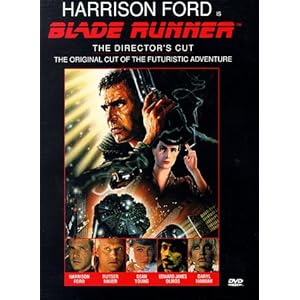
Thoughts on "Blade Runner"

Blade Runner
Going to school might sometimes be hard, and the loads of homework and assignments you get do not help. But being so lucky that your 'homework' is to watch a movie, you cannot complain. I watched Ridley Scott's 'Blade Runner' for the first time. I watched the directors cut, and have not seen any other versions of it.

Warning: Spoiler alert

I thought all in all it was a good movie, all though I still have troubles with the therm "cyberpunk". Before discussing this movie with any others, I sat there in the end wondering if Deckard was in fact a Replicant. In the end we see the unicorn origami, which you earlier had seen Gaff putting around - to show that he knew what the Replicants were dreaming. So by leaving the unicorn, which we saw earlier that Deckard had been dreaming about, this must mean that he is a Replicant too? But why is he so much weaker than the other Replicants? And we can ask ourselves why Roy did not kill him, when he had the chance? Was this because he was a Replicant, or that Roy had human feelings. I do now know, but I do know i liked the movie.

Unicorn Origami

Tuesday, August 14, 2012

File sharing: From Napster to BitTorrent


gomonews.com

In 1999, an American college student named Shawn Fanning created Napster. Napster was a file sharing computer service which was mainly used to share music in the format of MP3. 1.5 million people were using Napster in 2001 before it got shut down, after being dragged to court by the Recording Industry Association of America. (Napster 2012. Encyclopædia Britannica Online.)

Napster was the first-generation of peer-to-peer (P2P) file sharing, and after followed other P2P like for example ‘KaZaA’ which was created in 2000 by Niklas Zennström and Janus Friis. (Niklas Zennström 2012. Encyclopædia Britannica Online.)

Most of these different file sharing programs seems to have gotten in troubles with the copy right law, and many faced lawsuits. But it looks as many people won’t give up on file sharing, as it today is still very common – even though it is not all legal. I believe that the most common file sharing program today is BitTorrent, and these days’ people also download movies and TV series in addition to music files. 

To download files using a BitTorrent such at uTorrent which is one of the best clients (as it is free to use and comes without adware or spyware) you will need to go to a torrent search engine. There are many different search engines. Examples of these are ‘MiniNova’ and ‘the Pirate Bay’. Once you go there you will have to put in what you want to download in the search field and you will get options and then select the file you want. When you chose to download a torrent, it will automatically show up in your BitTorrent. And you're done - the download time depends on your internet speed. ('Using BitTorrent' 2010, Apc, 30, 4, p. 42, Australia/New Zealand Reference Centre)

I think Napster influenced today’s file-sharing because it is stilling going on, and I do not think people will stop sharing files in spite of the laws. Maybe one day it will be legal, but I understand that sharing files may affect the movie and music industry, as they probably lose money on people not buying their products because they choose to download it instead.  


References: 

'Using BitTorrent' 2010, Apc, 30, 4, p. 42, Australia/New Zealand Reference Centre, EBSCOhost, viewed 13 August 2012.

Napster 2012. Encyclopædia Britannica Online. Retrieved 13 August, 2012, from http://www.britannica.com.libraryproxy.griffith.edu.au/EBchecked/topic/754550/Napster 

Niklas Zennström 2012. Encyclopædia Britannica Online. Retrieved 13 August, 2012, from http://www.britannica.com.libraryproxy.griffith.edu.au/EBchecked/topic/1378578/Niklas-Zennstrom

(Post 6)

Sunday, August 12, 2012

Library tools and databases

I have been to the Griffith University Library tool online and searched for different books and journals from different authors, so that I can get familiarised with how to search for books, journals and databases, and also learn how to reference right.

Library tools
First I went into the Griffith University library tool and searched for Stephen Stockwell's books. These are my findings:

Stockwell, S 2005, Political campaign strategy: doing democracy in the 21st century, Australian Scholarly Publishing, Melbourne

Stockwell, S & Scott, P 2000, All-media guide to fair and cross-cultural reporting: for journalist, program makers and media students, Australian Key Centre for Cultural and Media Policy, Nathan, Qld

Isakhan, B & Stockwell, S (Eds) 2001, The secret history of democracy, Palgrave Macmillan, Basingstoke; New York

If  I were to write an essay on Jean Luc Godards 'Alphaville' I would use the library tool to find books that might be helpful. here are three examples of sources I could have used, and where to find them:

Sanders, S, 2008, The philosophy of science fiction film, University Press of Kentucky, Lexington, Ky
 - this book can be found in the library at College of Art in South Bank.

Buss, R 1994, French film noir, Marion Boyars, London; New York
 - this book can be found in the library in Nathan

Godard, J.L, 2000, Alphaville: a film, Faber and Faber Ltd, London
- this book can be found in the library at College of Art in South Bank, in Nathan and Gold Coast

If I wanted to do a book to do research on social media I could have used this: 

Poynter, R, 2010, The handbook of online and social media research: tools and techniques for market researchers, John Wiley and Sons
- this book is available online. 

Databases

Stephen Stockwell's first article about Brisbane:

Stockwell, S, 1995, ‘The Brisbane model: Considering a unique experiment’, Urban Policy and research, vol 13 no. 2, pp. 89
 
The newest article I found about Internet Addiction was one from Journal of Abnormal Child Psychology: 

Wymbs, B, McCarty, C, King, K, McCauley, E & Stoep, A et al, 2012, ‘Callous-Unemotional Traits as Unique Prospective Risk Factors for Substance Use in early Adolescents Boys and Girls’, Journal of Abnormal Child Psychology, vol 20, no 7, pp. 1099-1110

Print screen (griffith.edu.au)

(Post 5)